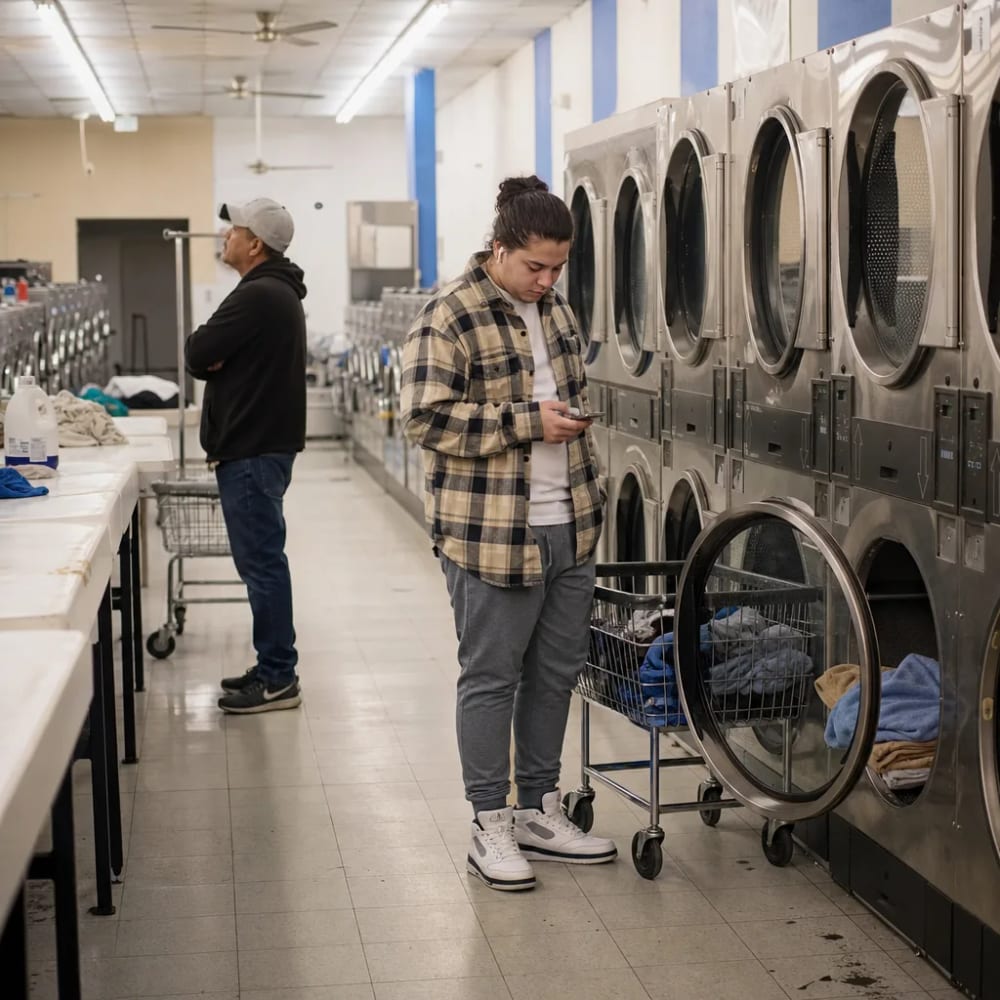
The 10 unspoken laundromat etiquette rules everyone should know all come down to one thing: everybody in the room is on a clock. Machines are shared, dryers are limited, and every minute someone leaves a load sitting costs another person time. Once you see etiquette as time management instead of manners, the rules stop feeling like rules.
Why Laundromat Etiquette Is Really About Shared Time, Not Just Manners
Here's the thing nobody says out loud. A laundromat isn't really a room full of machines. It's a room full of people's schedules stacked on top of each other.
You've got a mom with two kids who needs to be home by four. You've got a guy who works nights and this is his only free hour. And you've got someone who just wants to get in, get out, and get on with their Saturday in Hemet. Everybody's timeline is running at once.
So when a load sits finished in a washer for twenty minutes, that's not rude in some abstract way. That's twenty minutes taken from a real person standing right there.
We see this play out all the time. Someone starts a wash, walks across the lot to grab a coffee, and loses track of the clock. No bad intentions at all. But the room slows down, a line forms, and people start doing that thing where they hover near your machine and pretend they're not.
Ever walked in on a Saturday afternoon and every single dryer was full, but half of them were done and nobody was around? That feeling is exactly what etiquette is designed to prevent.
Think about what's being shared in the room:
- Machine time, which is the big one, especially on weekends and the first week of the month
- Folding table space, which is limited and disappears fast when someone spreads out
- Carts, which have a way of vanishing when three people need them at once
- Walking room between rows, which matters more than you'd think when someone's carrying a full basket
- Quiet, or at least a reasonable version of it, since a lot of folks are here for an hour or more
None of that is about being polite for politeness' sake. It's about not eating into somebody else's afternoon.
Hemet gets hot, and that changes the math too. In July, nobody wants to sit in a car waiting on a dryer. People come in, they want to move through, and they want to get back into air conditioning at home. Summer is when small delays feel a lot bigger.
The large capacity machines help here more than most people expect. One big load beats four small ones, and that frees up machines for the person behind you. Same goes for dryer-only service if your washing is already done at home. You're in and out, and the room keeps moving.
Most people don't think of themselves as the problem. And, most aren't. They just haven't thought about the room as a shared clock before.
Once you do, the rest of these rules make sense on their own.
Don't Leave Your Laundry Unattended for Too Long
Here's the rule nobody posts on the wall. Your machine finishes, you've got about ten minutes. After that, you're the person everyone's quietly annoyed at.
We see this every single day. Someone loads up, drives off to run errands, and comes back forty minutes late. Meanwhile three people are standing there with full baskets and nowhere to go.
And most folks aren't being rude on purpose. They just underestimate how fast a busy Saturday fills up in Hemet.
Think about it from the other side. You waited twenty minutes for a washer, it's been done for a half hour, the owner is nowhere in sight. What are you supposed to do? Touch a stranger's clothes? Nobody wants that.
So stay close. That's the whole rule.
If you do need to step out, keep it short and time it right. Here's how to stay on schedule without pacing the floor:
- Check the cycle length on the machine before you start it, not after.
- Set a timer on your phone for five minutes before the cycle ends.
- If you leave, pick something within a couple minutes of the building.
- Come back early, not on the dot. Machines finish faster than you think.
- Move your load to the dryer right away, then free up the washer.
- Pull your items out of the dryer the moment it stops, even if you fold at home.
That last step trips people up. Dryers get treated like storage lockers. They're not.
A dryer sitting full and cool is worse than a full washer, because dryer time is usually the bottleneck. If you're using a dryer-only visit to finish a load you started at home, you already know how much that wait stings.
Large capacity machines change the math a little too. A big load takes longer, so your timer should reflect that. Don't set it for a standard cycle and wonder why you're off by fifteen minutes.
Real scenario. A woman came in last summer with three weeks of laundry, started six machines, then walked over for lunch. She came back to see her wet laundry was piled in a cart, unavailable for other customers to use, and was upset an attendant removed her clothing. We pointed out signage that says to 'promptly remove clothing' and during busy times we will remove it so waiting customers can use. She understood. Now she brings a book and stays put, and she's in and out faster than before.
Staying with your laundry isn't just polite, it's faster for you. You move to the dryer sooner, you finish sooner, you go home sooner.
Timing expectations are one of the things covered in our house rules for customers, and they exist because they keep the floor moving for everybody on a packed weekend.
But what if you genuinely can't stay? Then plan a lighter visit. Bring fewer loads, or come during a slower stretch. Weekday mornings in Hemet are usually calm, late afternoons are not.
One more thing worth saying plainly. Unattended laundry sometimes walks away. Not often, but it happens, and there's no way to undo it.
So keep an eye on your stuff. Ten minutes is the grace period, treat it like a real deadline and you'll never be the story other customers tell. That same focus carries through the practical house rules guidance our team provides to local families.
Respect Other People's Laundry and Space
Here's the part nobody puts on a sign. Touching someone else's laundry feels wrong to most people, and it should. Clothes are personal. Underwear is personal. Your kid's soccer uniform with the grass stains is personal. So the default rule is simple: hands off unless you truly have no other option.
But we've all walked into a packed laundromat on a Saturday in Hemet and seen it. Every washer full. Nobody standing near any of them. Three people waiting with baskets on their hips.
What then?
If a load has been sitting done for a long stretch and the owner is nowhere around, most regulars agree it's fair to move it. Just do it the right way. Move it to a clean surface or an empty cart, never the floor. Keep it together in one pile. Don't shake anything out, don't sort it, don't inspect it.
And if the owner walks back in mid-move, be friendly about it. "Hey, it was done a while back and folks were waiting." Nine times out of ten that's the end of it.
- Check the machine display or lid to confirm the cycle is finished.
- Look around and ask out loud if the load belongs to anyone nearby.
- Give it a few minutes if you can spare them.
- Move the load into a clean cart or onto a clean folding table, all in one piece.
- Leave it somewhere visible so the owner spots it right away.
That last step matters more than people think. Tucking someone's clothes into a corner cart behind a column turns a small favor into a panic. We've watched a woman search the whole building for her work scrubs because someone hid the cart. Not on purpose. Just thoughtless.
Space is the other half of this. Folding tables are shared, they aren't your personal staging area. Spreading one load across an entire table while four people wait behind you is the fastest way to earn a dirty look.
- Use one section of the table, not the whole thing.
- Keep baskets under the table or beside your feet, not on top blocking space.
- Don't park a cart in the walkway between machine rows.
- Keep bags and purses out of the aisles where carts roll through.
- Fold and go, then come back for the next load if you've got several running.
Kids count too. A laundromat isn't a playground, and hot dryer doors are at exactly toddler height. Bring a tablet, a snack, a coloring book. Anything that keeps little ones planted near you and off the equipment.
One more thing on personal space. Headphones are your friend. Speakerphone calls carry across a tile room like nothing else, and so does music from a phone speaker.
None of this is complicated. It's just paying attention to the people around you, the same way you'd want them to pay attention to you.